I came across an article about this just recently that really intrigued me & thought it would be good to share some information with everybody else!
The Science Behind Canine Dry Rot Investigations
Is There Research?
Yes. 🔬
Scientific studies have shown that trained dogs can detect the scent of wood decaying fungi, including dry rot (Serpula lacrymans). Dogs are able to recognise the volatile organic compounds (VOCs) released by fungal growth even when it’s hidden behind walls or floors.
Why Dogs Are So Effective
- Dogs have up to 300 million scent receptors
- Humans have around 6 million
- This allows dogs to detect very small traces of fungal decay long before it becomes visible
How This Helps Buildings
Canine detection can:
- Locate hidden dry rot behind walls and under floors
- Reduce the need for destructive opening-up works
- Help target investigations more accurately
- Be especially useful in listed, heritage, or occupied buildings
Is This Used in Real Life?
Yes.
Specialist dry rot detection dogs are already being used in the UK on:
- Heritage and listed buildings
- Large commercial properties
- Complex structures where access is limited
They are used alongside traditional damp & timber surveys, not as a replacement.
Important to Know
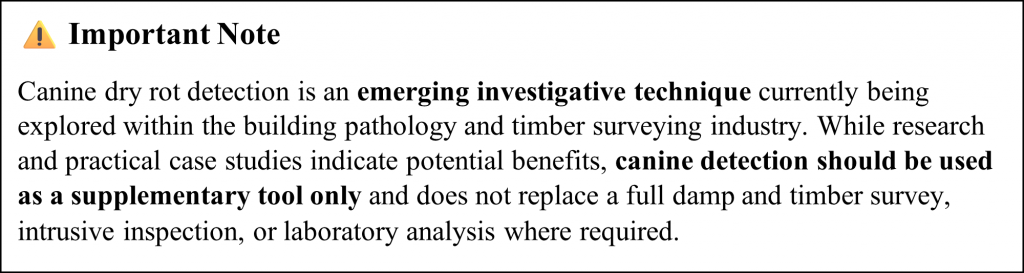
🐾 Canine detection is:
- A screening and investigative aid
- Not a standalone diagnosis
- Best used in combination with professional damp and timber surveys
Research and real-world use show that trained dogs can play a valuable role in dry rot investigations, helping surveyors identify problem areas early, accurately, and with minimal disruption.
Why Proven Survey Methods Still Matter
While these developments are intriguing, traditional damp and timber survey methods remain essential. Visual inspection, moisture profiling, invasive investigation where appropriate, and professional judgement are still the most reliable ways to:
- Confirm the presence of dry rot or other timber defects
- Assess the extent of decay and associated moisture sources
- Recommend effective and proportionate remedial works
Canine detection does not replace these processes. Instead, where used, it may help inform where closer inspection is required.
Our Approach
We keep a close eye on new research and emerging techniques within the industry so we can offer informed, up-to-date advice. However, our residential surveys continue to be based on proven, established methods, ensuring our clients receive clear, accurate findings they can rely on when making decisions about their homes.